
Concrete yards and farm slabs
Concrete for farm structures in Ireland is set by the Department of Agriculture's specification S.100. There are two mixes: Mix A, C35/45, for silage pits, slabs, aprons and effluent channels, and Mix B, C30/37, for everything else on the farm.
Exposed yard slabs where frost is a concern need Mix A, or Mix B with at least 3.5% air entrainment. The concrete has to come from a producer certified to I.S. EN 206.
Free, no obligation. One local concrete contractor prices it, not five.
S.100 Mix A and Mix B
| S.100 Mix A | S.100 Mix B | |
|---|---|---|
| Strength | 45 N/mm², class C35/45 | 37 N/mm², class C30/37 |
| Cement, minimum | 360 kg/m³ | 310 kg/m³ |
| Water/cement ratio, maximum | 0.50 | 0.55 |
| Slump | S2 or S3 | S2 or S3 |
| Aggregate, maximum | 20 mm | 20 mm |
| Used for | Silage pit walls, silage slabs and aprons, effluent channels and stores | All other farm structures, including slurry tanks that may take silage effluent |
The design life for agricultural buildings is 25 years, the Federation notes. For yard slabs open to frost, order Mix A or Mix B with at least 3.5% air entrainment.
Ordering and grants
- Order by name: "S.100 (Mix A)" or "S.100 (Mix B)", or by the full spec (strength, cement, water/cement ratio, slump, certified to I.S. EN 206 for use to S.100).
- For a grant claim, the Department wants a copy of the producer's annual I.S. EN 206 certificate and its specification certificate listing every delivery.
- A typical load is 7 m³: plan the order so the last load finishes the pour.
- Adding water on site is forbidden under I.S. EN 206. If you want a wetter mix, order S3, not S2.
- A loaded four-axle truck can weigh up to 32 tonnes, so the access needs a sound base and clear overhead lines.
Placing, finishing and curing
Slabs go on a stripped, stable base, backfilled with compacted hardcore. Vibrating screeds compact slabs up to 150 mm; deeper slabs need pokers of at least 50 mm, put in no more than 400 mm apart. Silage slabs can have a smooth trowelled finish; general yard slabs are better brushed for grip.
Then curing: keep the moisture in, especially for the first 7 days, with polythene fixed down, wet coverings, a mist spray or a curing compound. S.100 says a structure isn't fit for use until it has cured for at least 28 days, and longer is better before silage effluent reaches it.
Frost and yard slabs
External slabs, yards and driveways are the most vulnerable to frost, because they're thin and lose heat over a large area. Concrete must reach 5 N/mm² before it freezes, which means keeping it at 5°C or above for the first 48 hours. Salt and especially ammonia-based de-icers can damage the surface.
Floors laid by the contractor who takes your call
Calls on this site ring JAM Floor Screeding: James Mulhall, based in Portlaoise, 25 years laying floors. Lines open Mon to Sat, 7am to 6pm. He pours concrete floors, slabs and foundations as well as screed. These are his jobs.
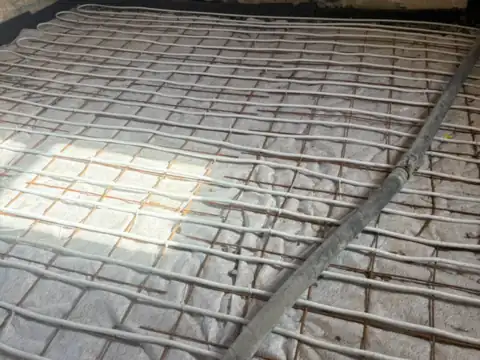
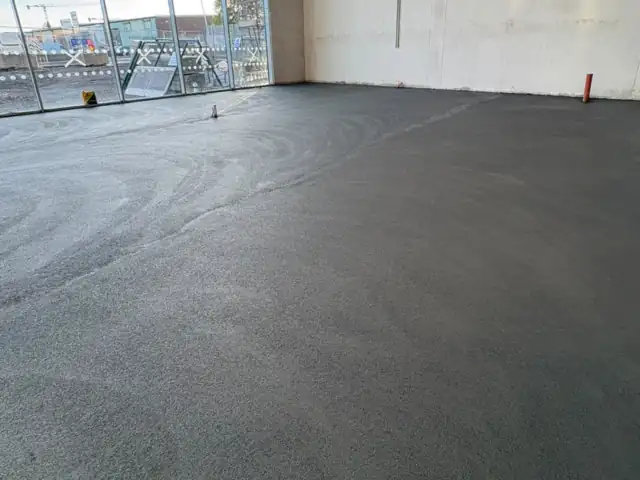

“JAM were punctual, professional and efficient and did an outstanding job on pouring our new floor as part of a renovation. Very highly recommend!”
“Excellent work, laser level finish, neat and tidy worker, highly recommend.”
“Top class work by james and his crew, highly recommend”
Quoted word for word from JAM Floor Screeding's Google reviews. Read them on Google
Get the job priced in 4 quick taps
Tell us about the job. It goes to one concrete contractor who covers your county, and they ring you to price it.
Concrete contractors guides & price breakdowns
Straight answers to what people ask most: itemised costs, specifications, planning or grants, and what to check before you book.
More guides & resources: Concrete vs screed · Slab depth for an extension · Building Regulations for concrete · All guides & calculator hub · Technical & trade glossary · Frequently asked questions · All areas covered · About this site
Yards and farm slabs questions
What concrete do I need for a farm yard?
S.100 Mix B (C30/37) for general farm structures. For exposed yard slabs where frost is a concern, Mix A (C35/45) or Mix B with at least 3.5% air entrainment.
What concrete is used for a silage slab?
S.100 Mix A: C35/45, at least 360 kg/m³ of cement, water/cement ratio no more than 0.50.
What paperwork do I need for a grant?
The concrete producer's annual I.S. EN 206 certificate and its specification certificate listing every delivery, submitted with the claim.100 guide.
How long before a new yard slab can be used?
S.100 says not before 28 days of proper curing, and longer is better for silage structures.
Can water be added to the concrete on site?
No. Adding water on site is forbidden under I.S. EN 206; only the producer's technical staff can authorise it, with cubes taken after. Order a wetter slump class instead.
Concrete contractors across all 26 counties
Requests from all 26 counties go to one vetted local specialist who covers your county — from Dublin, Cork, Galway and Limerick to Kildare, Meath, Wicklow, Waterford and Donegal. Pick your county below for local prices, specifications and advice. Compare all areas covered →
Get a free quote for the job
Four taps and your number. One concrete contractor who covers your county rings you with a price. Nothing is booked until you say yes.